Episode Transcript
[00:00:00] Speaker A: I mean, imagine handing the keys to a million dollar physical asset to a complete stranger.
[00:00:05] Speaker B: Right.
[00:00:05] Speaker A: And knowing that if they, you know, systematically dismantled the property, the tech company that facilitated the transaction is just going to rely on an automated chat bot to deny your claim.
[00:00:17] Speaker B: Yeah. It is a staggering assumption of risk.
[00:00:19] Speaker A: It really is. For years, the decentralized single family short term rental market has been marketed to institutional and retail investors alike as. As the ultimate passive income vehicle.
[00:00:31] Speaker B: But when you strip away the marketing and actually look at the underlying arithmetic, you are looking at a profound structural market failure.
[00:00:40] Speaker A: Exactly. We have a situation where tech platforms capture asset light transaction fees while forcing the actual operators to shoulder 100% of the physical capital risk.
[00:00:50] Speaker B: The illusion of the decentralized cash cow is fracturing.
[00:00:53] Speaker A: It's completely fracturing.
[00:00:54] Speaker B: But by the end of this briefing, you will understand the exact mathematical and operational advantage of consolidating scattered short term rental assets into commercial hospitality properties.
[00:01:05] Speaker A: Right. To neutralize that platform dependency risk and protect your capital.
[00:01:08] Speaker B: Exactly.
[00:01:09] Speaker A: So let's break down the core mechanics and technical hurdles of this asset.
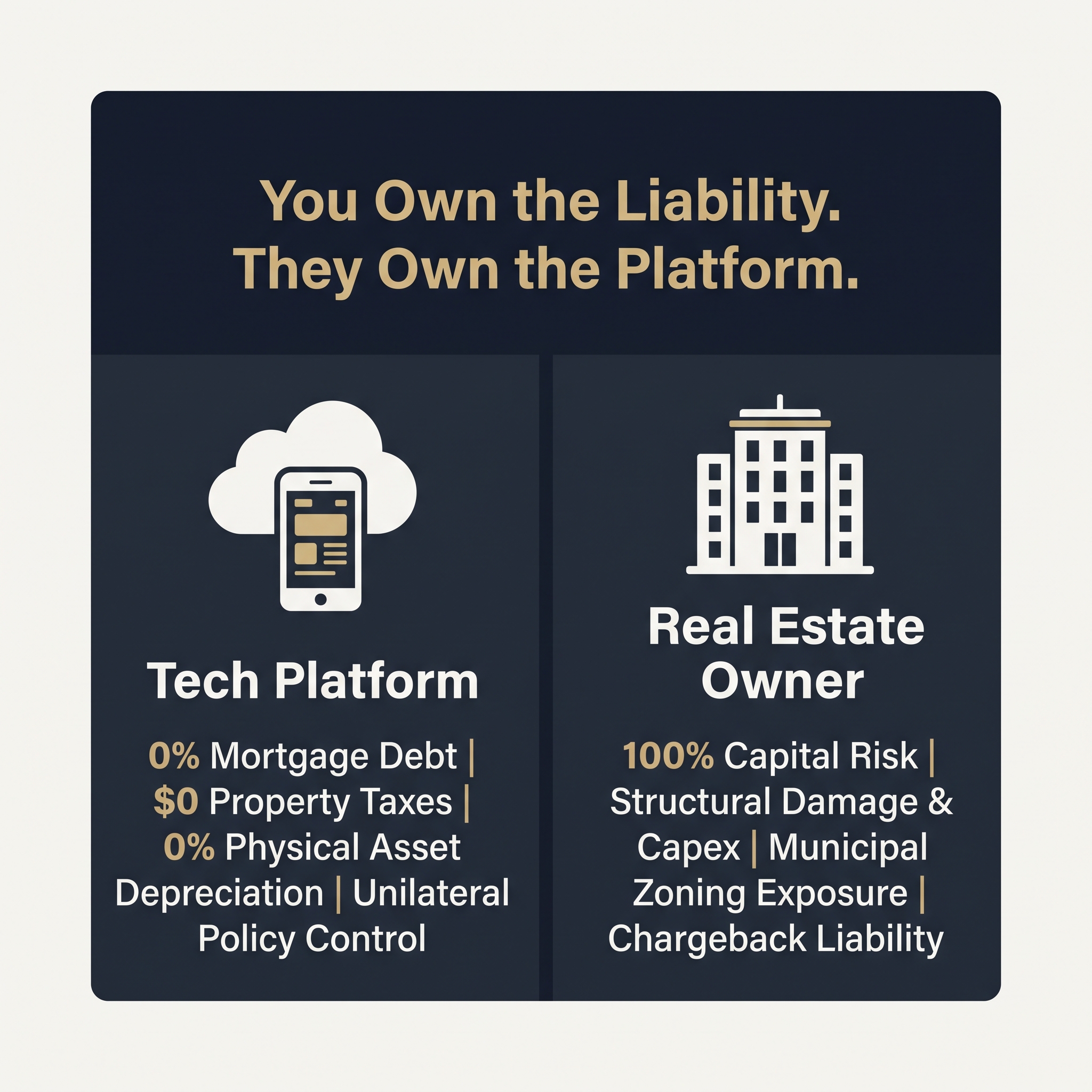
[00:01:13] Speaker B: Well, the foundational issue here is a severe capital risk asymmetry. I mean, we really need to look
[00:01:21] Speaker A: at the balance sheets, because these booking platforms, they operate purely as software companies. Right.
[00:01:26] Speaker B: They carry zero mortgage debt, they hold no maintenance expenses, no property taxes, and
[00:01:31] Speaker A: absolutely no physical asset depreciation on their ledgers.
[00:01:34] Speaker B: Precisely.
[00:01:35] Speaker A: Yeah.
[00:01:36] Speaker B: Yet despite holding zero physical equity, they possess this unilateral authority to dictate the operational rules of engagement.
[00:01:44] Speaker A: Yeah.
[00:01:44] Speaker B: They control your cancellation policies, they adjudicate credit card chargeback liabilities, and they ultimately determine the outcomes of any guest disputes.
[00:01:52] Speaker A: Which is wild when you think about it.
[00:01:54] Speaker B: It is. We're looking at a peer to peer hosting model that is effectively mutated.
[00:01:58] Speaker A: Yeah.
[00:01:58] Speaker B: It has turned property owners into uncompensated underwriters for the platform's unvetted liabilities.
[00:02:05] Speaker A: Wait, I need to pause and stress test that analogy. You are essentially saying that if a tech platform holds all the leverage but zero physical liability, the investor is just, you know, outsourcing their business risk without retaining any actual control over revenue stability.
[00:02:23] Speaker B: Precisely. I mean, you own the liability, but you lease the control.
[00:02:26] Speaker A: Right.
[00:02:27] Speaker B: And the operational friction squeezing margins in this space is no longer theoretical.
[00:02:32] Speaker A: Right.
[00:02:33] Speaker B: It is actively eroding net operating income across the board.
[00:02:36] Speaker A: We're seeing it everywhere.
[00:02:37] Speaker B: Yeah. We are observing a distinct measurable widening of the gap between what incentivizes the platform and what actually protects the host's balance sheet.
[00:02:47] Speaker A: And a primary driver here is the shift toward host Only fees. Right. And the deployment of these AI mediated claim systems.
[00:02:53] Speaker B: Exactly.
[00:02:54] Speaker A: Walk us through the mechanics of that divergence. Like why are those incentives inherently opposed?
[00:02:59] Speaker B: Because the platforms are optimizing entirely for frictionless guest experiences and gross booking volume.
[00:03:04] Speaker A: Right. They need the transaction to occur with zero friction so they can capture their fee.
[00:03:08] Speaker B: Exactly. The host meanwhile, is optimizing for asset preservation and yield.
And those two objectives become fundamentally opposed the moment physical damage occurs.
[00:03:19] Speaker A: Right.
[00:03:20] Speaker B: When a guest damages a property, the platform's algorithm is designed to resolve the friction quickly, usually by minimizing the host's payout. So the guest continues to use the platform in the future.
[00:03:31] Speaker A: And the scale of these physical liabilities is often just completely misrepresented in standard pro forma models.
[00:03:37] Speaker B: Oh, entirely.
[00:03:37] Speaker A: We aren't talking about, you know, a broken wine glass or a stained rug.
[00:03:41] Speaker B: No. Or a scuffed baseboard.
[00:03:43] Speaker A: Right. We are observing instances where unvetted guests are converting residential homes into unauthorized commercial ventures.
[00:03:50] Speaker B: Yeah.
[00:03:51] Speaker A: We are talking about assets being utilized
[00:03:53] Speaker B: as pop up hardware labs or unlicensed crypto mining setups.
[00:03:57] Speaker A: Literally melting the home's electrical panels due to the continuous power draw.
[00:04:01] Speaker B: Yeah, it's incredible.
[00:04:02] Speaker A: And we see full blown ticketed underground party houses.
[00:04:07] Speaker B: Right. And when that catastrophic damage occurs, the reactive coverage windows provided by platforms programs like Air cover frequently just fail under the scrutiny of actual deployment.
[00:04:19] Speaker A: Because the marketing suggests you're protected up to what, several million dollars?
[00:04:23] Speaker B: Yeah, but the operational reality of extracting that capital is entirely different.
Owners are consistently left absorbing five figure repair bills and critically, the associated lost revenue from the property's downtime.
[00:04:36] Speaker A: Because the platform's algorithm simply routes the next traveler to a different listing.
[00:04:41] Speaker B: Exactly. While the owner just eats the capital loss.
[00:04:43] Speaker A: To truly understand the resulting yield compression, we need to examine the granular bottlenec.
Because there are three key vulnerabilities currently destabilizing residential short term rental underwriting. Let's dissect the first one. The dispute and claim bottleneck.
[00:04:58] Speaker B: Yeah, this is a big one.
[00:04:59] Speaker A: Explain how this AI driven triage actually functions against the host.
[00:05:03] Speaker B: Well, the platforms utilize automated AI driven triage systems that demand an impossibly tight standard of proof. And they do it within highly compressed operational windows. Right.
[00:05:14] Speaker A: Typically, hosts are required to submit full documentation of damage within 14 days or crucially, before the next guest checks in.
[00:05:21] Speaker B: Let's apply that to a real world operational timeline, because that is where the math really falls apart. Okay, let's say you have a same day turnover, checkout is at 11:00pm and your cleaning crew arrives at say, 11:15am Right. And the next guest checks in at 4.
[00:05:37] Speaker A: 00pm Exactly. If the cleaning crew discovers a destroyed electrical panel at 11:15am you have a matter of hours to document the damage.
[00:05:45] Speaker B: Hours?
[00:05:45] Speaker A: Yeah, you have to secure a binding estimate from a licensed contractor and file a flawlessly formatted claim before the algorithm invalidates your recovery attempt. The exact moment that 4.0pm guest walks through the door.
[00:05:59] Speaker B: Which is physically impossible in many markets. I mean, just trying to get a contractor out on a Sunday afternoon to write an estimate.
[00:06:05] Speaker A: It's never going to happen.
[00:06:06] Speaker B: Right.
[00:06:06] Speaker A: The system is functioning as an administrative labyrinth and explicitly designed to minimize platform payouts. It operates as a feature, not a bug. Which brings us to the second vulnerability review. Weaponization. This is such a fascinating psychological friction point.
[00:06:22] Speaker B: It really is.
[00:06:23] Speaker A: You have older standard residential assets, Right? Perhaps a charming 1940s bungalow.
[00:06:28] Speaker B: Yeah.
[00:06:29] Speaker A: And they're being judged by consumers who are bringing the expectations of corporate hotel perfection.
[00:06:34] Speaker B: It is a completely asymmetrical expectation.
[00:06:37] Speaker A: Exactly.
[00:06:38] Speaker B: When friction occurs, say the host attempts to hold the guest accountable for a clear violation of house rules like sneaking in unauthorized pets or throwing up party. Guests frequently retaliate by weaponizing a one star review.
[00:06:53] Speaker A: They will claim the house was dusty or the wi fi dropped.
[00:06:56] Speaker B: Exactly. And the mathematical impact of that is severe because the platform's algorithmic ranking dictates top of funnel visibility.
[00:07:02] Speaker A: Right. A single retaliatory review can push a listing from page one to page four easily.
[00:07:07] Speaker B: And that can significantly depress occupancy rates for three to six months.
[00:07:11] Speaker A: So hosts realize very quickly that they are effectively held hostage.
[00:07:14] Speaker B: Yeah, they find themselves waiving completely valid thousand dollar damage claims simply to protect their search ranking and preserve their future cash flow.
[00:07:24] Speaker A: You are essentially paying extortion money in the form of absorbed damages to maintain your algorithm status.
[00:07:30] Speaker B: That is yield compression via algorithmic coercion.
[00:07:33] Speaker A: It's brutal.
[00:07:34] Speaker B: And the third vulnerability is the financial drag introduced by Deferred Payment Options.
The platforms have rolled out features like reserve now, pay later.
[00:07:43] Speaker A: Right, which from a macroeconomic standpoint, these features are highly effective at locking calendar availability.
[00:07:49] Speaker B: Yeah, which artificially boosts the platform's forward looking metrics for their quarterly earnings calls.
[00:07:55] Speaker A: But the mechanism of that transaction shifts the credit card chargeback liability entirely to the property owner post checkout.
[00:08:02] Speaker B: Exactly.
[00:08:03] Speaker A: If a guest completes a two week stay, goes home and disputes the charge with Visa or MasterCard. The platform does not utilize its multi billion dollar legal team to fight that dispute on your behalf.
[00:08:15] Speaker B: No, they simply claw back the funds from the host's connected bank account.
[00:08:19] Speaker A: Unbelievable.
[00:08:20] Speaker B: The host is unwittingly underwriting the consumer credit risk of the platform's customer.
[00:08:24] Speaker A: This brings us to a critical analytical juncture regarding operational scaling limits.
Let's look at how institutional capital typically approaches this.
[00:08:33] Speaker B: Right.
[00:08:34] Speaker A: A standard pro forma spreadsheet might display a highly attractive Yield, say a 12%
[00:08:40] Speaker B: capitalization rate, on a portfolio of 10 separate single family rentals spread across multiple municipal jurisdictions.
[00:08:48] Speaker A: And on paper, it looks like healthy geographic diversification.
[00:08:51] Speaker B: But that's exactly how Pre saw what the spreadsheets missed.
[00:08:54] Speaker A: Right.
[00:08:55] Speaker B: When you acquire 10 residential units across three different townships, you do not own a scalable portfolio. You own 10 completely separate operational headaches.
[00:09:05] Speaker A: I mean, you are managing 10 different
[00:09:06] Speaker B: roofs, 10 distinct sets of municipal zoning codes.
[00:09:09] Speaker A: Yeah. 10 different H vac systems. And you are trying to route multiple cleaning and maintenance crews across a fractured geographic footprint.
[00:09:17] Speaker B: The logistical overhead destroys the margin. The spreadsheet assumes a flat maintenance cost. It does not factor in a plumber charging triple time to drive 40 minutes between two distinct suburban assets on a holiday weekend.
[00:09:30] Speaker A: The geographical friction involved in turnover compliance and vendor management completely erodes the yield that the model promised.
[00:09:38] Speaker B: And this geographical fragmentation is particularly lethal when we look at hyper local micro
[00:09:44] Speaker A: market nuances, Especially in the central Ohio and broader midwest markets.
[00:09:48] Speaker B: Yes, in these specific regions, municipal regulations regarding short term rentals are highly volatile.
[00:09:55] Speaker A: Legislative fragility is the hidden risk premium here.
[00:09:58] Speaker B: Exactly. A single township council vote on a Tuesday night can outlaw non owner occupied
[00:10:04] Speaker A: rentals effective immediately, which instantly reduces a high performing hospitality asset back to a standard long term rental.
[00:10:11] Speaker B: And the problem is the long term rental cap rate, the net operating income divided by the asset value no longer supports the initial leverage you use to acquire the property.
[00:10:20] Speaker A: Because the debt service remains based on short term rental revenue.
[00:10:24] Speaker B: Right.
[00:10:24] Speaker A: But your legally permissible income just dropped by 50%.
[00:10:27] Speaker B: An institutional capital allocation strategy simply cannot survive on that level of legislative fragility.
[00:10:34] Speaker A: We are seeing severe yield compression not just from increased operating expenses, but from the elevated risk premiums required to hold decentralized residential assets.
[00:10:44] Speaker B: Now, to maintain strict analytical rigor, we must acknowledge the counter data.
[00:10:49] Speaker A: Right. If the platform holds all the leverage and the host holds all the risks, why does this ecosystem still exist?
[00:10:57] Speaker B: Because the major booking platforms possess distinct advantages that cannot be replicated by independent operators.
[00:11:03] Speaker A: Primarily, they provide unmatched global demand generation.
[00:11:07] Speaker B: Exactly. Their top of funnel guest acquisition is unparalleled because they are operating with multi billion dollar marketing budgets.
[00:11:14] Speaker A: Furthermore, they are continuously updating platform level identity verification protocols. And fraud detection systems which an individual
[00:11:21] Speaker B: host simply does not possess the capital or the technical infrastructure to build independently.
[00:11:25] Speaker A: They are undeniably powerful distribution channels.
[00:11:28] Speaker B: But here is where the underwriting actually gets weird. To survive this structural failure, seasoned operators aren't just changing their digital marketing strategy. They are completely restructuring their physical footprint.
[00:11:41] Speaker A: Moving on to our next major pillar. How this exposure was entirely neutralized.
[00:11:46] Speaker B: The first phase of salvaging the asset class and protecting invested capital involves intentionally severing platform dependency.
[00:11:53] Speaker A: Right.
[00:11:54] Speaker B: This requires the implementation of a robust direct booking infrastructure.
Serious well capitalized operators are systematically removing themselves from the platform's mediated ecosystems.
[00:12:06] Speaker A: What does that actually look like?
[00:12:08] Speaker B: Operationally, it means they are integrating independent merchant processors.
They are establishing direct relationships with banks to control their own capital flow and fight their own chargebacks.
[00:12:18] Speaker A: Okay.
[00:12:18] Speaker B: They're deploying specialized third party identity verification software to properly vet guests, government IDs and criminal backgrounds before a reservation is ever confirmed.
[00:12:28] Speaker A: And crucially, they are securing private commercial short term rental insurance policies.
[00:12:34] Speaker B: This is a vital distinction. These policies are underwritten by actual insurance carriers and entirely bypassing the arbitrary dispute mediation of the tech platforms.
[00:12:45] Speaker A: Right. You stop relying on an overseas customer service representative's subjective interpretation of a constantly changing platform policy.
[00:12:52] Speaker B: Exactly. And you start relying on a legally binding regulated commercial insurance contract.
[00:12:58] Speaker A: That digital restructuring is necessary, but it is only the first step.
[00:13:03] Speaker B: Yeah. The definitive creative strategy deployed by elite operators is a fundamental shift in brand architecture and physical real estate.
[00:13:10] Speaker A: We are seeing a rapid calculated pivot it away from scattered residential single family units and a strategic consolidation into 20 to 40 key boutique hotels and independent motels.
[00:13:20] Speaker B: This is where we really examine the specific market intelligence dispatched from Priyanshu Athothakar.
[00:13:25] Speaker A: Right. The premier commercial real estate and hotel investment advisor and licensed Realtor.
[00:13:29] Speaker B: You know, pre's boots on the ground approach to identifying vintage roadside motels or underutilized midterm rental corporate placements allows operators to consolidate their operations under a single roof.
[00:13:41] Speaker A: Let's analyze the mechanics of that consolidation.
Putting 20 to 40 keys under one contiguous roof is the exact mechanism that unlocks true operational scale.
[00:13:52] Speaker B: First, you eliminate the geographic friction we discussed earlier.
[00:13:55] Speaker A: Right.
[00:13:56] Speaker B: You centralize your staffing. You now have one housekeeping team moving efficiently door to door rather than driving across town.
[00:14:04] Speaker A: You operate one commercial laundry facility on site.
[00:14:08] Speaker B: You deploy one maintenance technician to service identical PTAC H VAC units.
[00:14:12] Speaker A: Wait, I need to push back on this assumption for the listener.
[00:14:15] Speaker B: Sure.
[00:14:15] Speaker A: You are telling an investor who is struggling to manage three suburban homes to go out and acquire a 40 unit commercial motel.
[00:14:22] Speaker B: I am.
[00:14:23] Speaker A: That sounds like multiplying the physical risk, not neutralizing it. How does taking on a massive commercial facility actually lower the portfolio's risk profile?
[00:14:32] Speaker B: Because you are trading scattered operational risk for centralized, legally protected commercial stability. When you consolidate into a motel, you acquire commercial zoning protection. You are no longer subject to the whims of a residential homeowner association.
[00:14:45] Speaker A: Right. You are insulated from arbitrary township crackdowns on neighborhood short term rentals because you are operating a commercially zoned, legally recognized hospitality business.
[00:14:56] Speaker B: Exactly. The municipality wants you there to collect the lodging tax. You transition from being a neighborhood nuisance to a recognized municipal revenue driver.
[00:15:06] Speaker A: However, this transition requires a brutal financial re engineering.
[00:15:10] Speaker B: Oh, absolutely.
[00:15:11] Speaker A: This is not residential real estate, and residential assumptions will lead to immediate institutional failure here. Underwriting a boutique hotel requires strict commercial real estate rigor.
[00:15:20] Speaker B: Yes. When you acquire an aging roadside motel for adaptive reuse, you must rigorously model extensive property improvement plans, or PIPs.
[00:15:30] Speaker A: Right, the PIPs.
[00:15:31] Speaker B: A PIP is the required capital expenditure to bring a tired asset up to modern competitive brand standards.
[00:15:37] Speaker A: So you are replacing roofs, updating commercial plumbing lines and installing electronic key card systems.
[00:15:43] Speaker B: Furthermore, you are dealing with active payroll management, commercial grade life safety compliance, fire suppression systems, and highly strict occupancy forecasting.
[00:15:52] Speaker A: You are no longer analyzing gross monthly rent. You are analyzing rev PR revenue per available room.
[00:15:59] Speaker B: Let's define that mechanism. You take your average daily rate and multiply it by your occupancy rate.
[00:16:04] Speaker A: Right. If you have a 40 key property and 15 rooms are empty on a Tuesday night, your dynamic pricing strategy has to carry the weight of that vacancy on a daily basis.
[00:16:14] Speaker B: It is a completely different mathematical game than hoping a family pays their lease on the first of the month.
[00:16:19] Speaker A: Yeah. The transition from decentralized residential to consolidated commercial fundamentally alters both the capital stack and the operational profile of the operator.
[00:16:29] Speaker B: Well, as PRI points out in this week's perspective, you must treat this with the respect a full time operating business demands.
[00:16:35] Speaker A: Exactly.
[00:16:36] Speaker B: Success here relies on disciplined rev PR management, robust capital expenditure reserves and highly monitored commercial cash flow. You cannot run a 40 unit motel
[00:16:46] Speaker A: on residential hope if your underwriting model does not meticulously account for commercial taxation rates, dedicated marketing budgets for direct customer acquisition and comprehensive commercial liability coverage.
The asset will rapidly underperform the debt service.
[00:17:02] Speaker B: And that brings us to the ultimate synthesis of this intelligence.
[00:17:06] Speaker A: The bottom line is that booking platforms are distribution channels. They are not and never have been a business model.
[00:17:13] Speaker B: Right. A distribution channel is merely a spigot. It can be altered, restricted, algorithmically throttled or entirely shut off by a third party software update at any moment.
[00:17:23] Speaker A: Long term durability in hospitality real estate fundamentally requires owning the direct customer relationship, diversifying your reven across multiple direct and third party channels, and most importantly, controlling the physical asset under a highly scalable consolidated commercial structure.
[00:17:40] Speaker B: If your institutional capital is deployed in a manner where a minor algorithm update out of Silicon Valley can instantly eliminate your net profit margin, you're entirely mispriced for risk.
[00:17:50] Speaker A: Exactly. The equation for survival in the current market environment is strict physical consolidation and absolute operational sovereignty.
[00:17:59] Speaker B: Which leaves us with the definitive question for anyone holding these assets.
[00:18:03] Speaker A: Does your current portfolio structure truly reflect ownership and control of a scalable business, or have you simply spent millions of dollars to manage the physical liabilities on behalf of a tech platform?
[00:18:14] Speaker B: You've got the perspective. Now it's time to drive the news forward to ensure you never miss a market shift. Tap subscribe on Spotify, Apple Podcasts or wherever you listen.
If today's insights are going to impact your strategy, share this episode with a colleague or investment partner who needs to see the big picture.
For actionable guides, newsletter subscriptions and direct advisor consultation, head over to Barrivestors.com thank you for listening. We'll watch the market closely until next week.